
Every small business needs 7 core legal documents: a formation document, an operating agreement, a client contract, a nondisclosure agreement, an employment or contractor agreement, a privacy policy, and an intellectual property assignment clause. Skip even one and you face personal liability, unenforceable deals, or costly IRS audits.
This guide covers all 7, explains what each document actually does, and plainly tells you which ones you can handle with a free template and which are worth paying a small-business attorney to draft properly.
Nearly 1 in 5 small businesses lost over $5,000 to preventable legal issues last year, according to Business Wire research cited by legal professionals nationwide. Most of those losses traced back to missing or poorly drafted documents that any business owner could have put in place before their first client or first hire.
The good news: most of these documents are a one-time task. Get them in place once, and they protect every deal, hire, and client relationship going forward.

Why Legal Documents Matter More Than Most Owners Realize
A handshake deal feels fast and friendly. The problem is that verbal agreements are nearly impossible to enforce in court. When a client disputes payment, when a contractor claims they own the logo they designed for you, or when a former employee joins a competitor and takes your client list, your only protection is a signed document.
Legal documents do three things simultaneously:
- They create a legal entity barrier that separates your personal assets from your business debts and lawsuits.
- They set enforceable expectations so disputes have a written reference point rather than a “he said, she said” argument.
- They satisfy lenders and investors who will not provide capital to a business that cannot produce basic formation and governance documents.
| Document You Skip | What It Can Cost You |
| Operating agreement | Personal assets exposed in a lawsuit or business dispute |
| Client contract | Unpaid invoices with no legal recourse to collect |
| NDA | Trade secrets leaked with no legal remedy available |
| IP assignment clause | Contractors legally own the work you paid for |
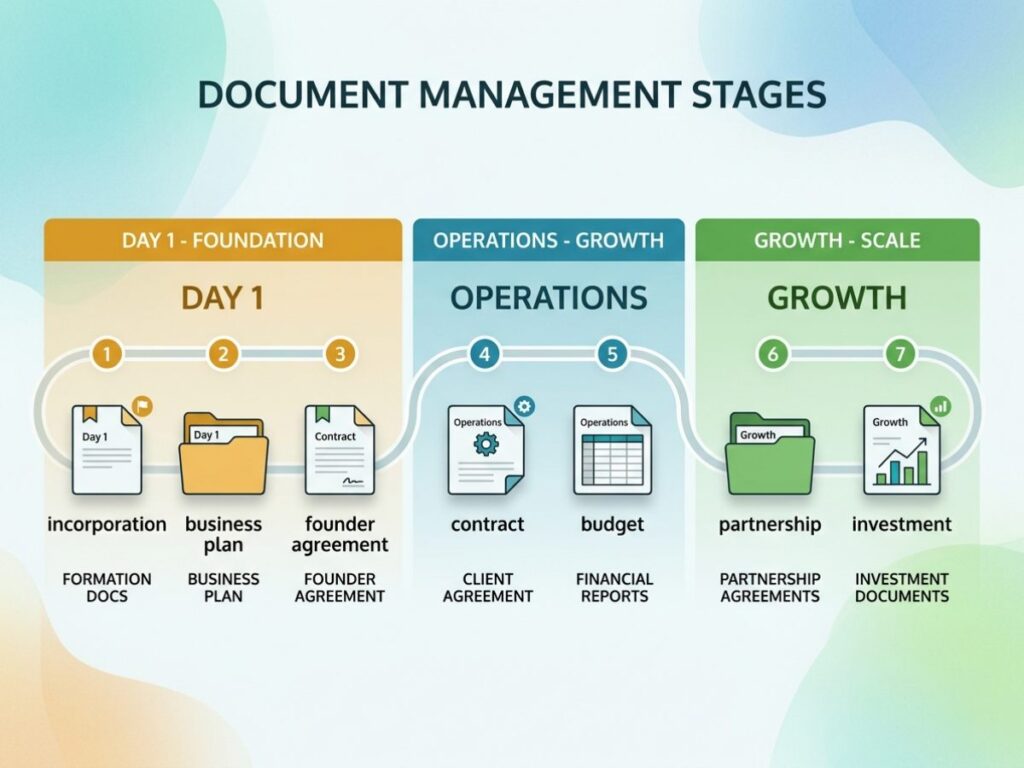
Not every document needs a lawyer. But several of them do, and knowing which is which saves you both money and risk. The 7 documents below are organized by when you need them, from Day 1 through your first hire and beyond.
The 7 Legal Documents for Small Business, Organized by Stage
1. Business Formation Document (Stage: Day 1)
Your formation document is the legal paperwork you file with your state to create a recognized business entity. The specific document depends on your structure:
- LLC: Articles of Organization, filed with your state Secretary of State
- Corporation: Articles of Incorporation, also filed with the state
- Sole proprietorship: A DBA (Doing Business As) filing if you operate under a name other than your own
Once filed and approved, your business exists as a separate legal entity. That separation is the foundation of personal asset protection. Without it, a lawsuit against your business is a lawsuit against you personally, including your home, car, and personal savings.
DIY or hire a lawyer? Most single-owner LLCs can file formation documents directly through their state’s Secretary of State website for a filing fee that typically ranges from $50 to $500, depending on the state. Multi-member LLCs and any corporation structure benefit from attorney guidance, as the decisions made at formation (equity splits, share classes, governance rules) are difficult to undo later.
The U.S. Small Business Administration provides a plain English guide to choosing the right structure before you file.
2. Operating Agreement or Corporate Bylaws (Stage: Day 1)
Filing your formation documents creates the shell of your business. Your operating agreement or bylaws define how that business actually runs. These are internal governance documents and among the most overlooked on the entire business legal checklist.
For an LLC, an operating agreement template covers:
- Ownership percentages for each member
- How profits and losses are distributed
- Who makes decisions, and how votes are counted
- What happens when a member wants to leave or sell their share
- How the company dissolves if needed
For a corporation, bylaws cover similar ground: director responsibilities, shareholder meeting procedures, voting rights, and officer roles.
What happens without one: When there is no operating agreement, state default rules govern your LLC. Those default rules are generic and often unfavorable. They may require unanimous consent for basic decisions or split profits equally, regardless of each member’s actual investment. Disputes without a written governance document are expensive to resolve and sometimes end in dissolution.
DIY or hire a lawyer? A single-member LLC operating agreement is one of the most template-friendly documents on this list. Reputable free and low-cost templates are widely available. Multi-member LLCs and corporations should work with a business lawyer because the governance decisions you embed here have long-term consequences.
3. Client or Service Contract (Stage: Before Your First Client)
A client contract is a written agreement that specifies the scope of work, payment terms, project deliverables, revision limits, and the process for ending the relationship early. It is one of the most critical contracts for any service-based business.
Without a signed contract, a client can:
- Dispute the invoice after the work is complete
- Demand unlimited revisions with no additional pay
- Claim ownership of deliverables or intellectual property
- Walk away mid-project, leaving you with no legal path to collect payment
A good client contract does not have to be long. A single-page service agreement that covers scope, payment schedule, late-payment terms, and cancellation conditions protects most engagements. Once you draft one, you can reuse it as a template for every new client with minor adjustments.
DIY or hire a lawyer? Template-based contracts are acceptable for straightforward, lower-value service engagements. If your contracts involve large sums, complex deliverables, or work for enterprise clients who may push back with their own contract language, attorney review is worth the investment.
4. Nondisclosure Agreement (Stage: Before Sharing Proprietary Information)
A nondisclosure agreement (NDA) is a legally binding contract that prevents the person signing it from disclosing your confidential business information to third parties or using it for their own benefit.
NDAs are not just for tech startups. Every small business has information worth protecting: pricing structures, supplier relationships, client lists, product formulas, or internal processes. An NDA puts legal teeth behind that protection.
You need an NDA before sharing sensitive information with:
- Potential business partners during early discussions
- Contractors who will work with proprietary systems or data
- Employees who handle customer information or trade secrets
- Vendors who integrate with your internal operations
DIY or hire a lawyer? Mutual NDAs, where both parties agree to keep each other’s information confidential, follow well-established templates and are safe to use without attorney involvement in most cases. One-sided NDAs signed by employees, especially those that include noncompete provisions, carry more legal nuance and vary significantly by state. Have those reviewed by a small business attorney before use.
5. Employment Agreement or Independent Contractor Agreement (Stage: Before Your First Hire)
This is one of the most consequential documents on the entire small business legal requirements list, and one of the most commonly mishandled.
When you bring on a worker, you must decide: are they an employee or an independent contractor? The IRS and most state labor agencies apply specific tests to make that determination, and misclassification carries significant penalties, including back taxes, interest, and fines. The classification is not simply a matter of what you both prefer to call the arrangement.
An employment agreement for a full-time or part-time employee should cover:
- Job title, responsibilities, and compensation
- Benefits and paid time off
- Ownership of work created on company time
- Confidentiality obligations
- Noncompete terms, if applicable and legally enforceable in your state
- Grounds and process for termination
An independent contractor agreement should specify:
- Project scope and deliverables
- Payment structure and schedule
- Who owns the intellectual property created
- Confidentiality requirements
- The contractor’s status as an independent party, not an employee
DIY or hire a lawyer? Basic contractor agreements for straightforward freelance work can follow templates available from reputable legal document services. Employment agreements, especially those that include noncompete clauses, should always be drafted or reviewed by a business lawyer. Noncompete enforceability varies dramatically by state, and a poorly drafted clause is either unenforceable or dangerously broad.
The IRS independent contractor classification guidance is the authoritative reference for understanding how the federal government distinguishes the two categories.
6. Privacy Policy and Website Terms of Use (Stage: Before Your Website Goes Live)
If your website collects any information from visitors, including email addresses, contact form submissions, payment details, or analytics data, you are legally required to have a privacy policy. This is not optional. Laws such as GDPR, CCPA, and CAN-SPAM all have enforcement mechanisms and real financial penalties.
Your privacy policy must disclose:
- What data do you collect, and how do you collect it
- How you use that data
- Whether you share it with third parties
- How users can request that their data be deleted
Your terms of use (also called terms of service) establish the rules for using your website, limit your liability for content errors, and give you the legal right to remove users or content that violates your policies.
Beyond legal compliance, missing these documents creates a practical business problem. Most major email marketing platforms, including Mailchimp, Klaviyo, and ConvertKit, require a published privacy policy before allowing you to use their services.
DIY or hire a lawyer? Privacy policy generators such as Termly and iubenda produce legally compliant documents for most basic business websites and are widely accepted by courts and platforms. If your business handles sensitive data, processes payments, operates in multiple countries, or runs an e-commerce store, attorney review is the right call.
7. Intellectual Property Assignment Agreement (Stage: Before Work Begins with Any Contractor)
This is the document most small business owners have never heard of until something goes wrong. And when something goes wrong, it goes very wrong.
By default, under U.S. copyright law, independent contractors own the work they create, even if you paid for it. A logo, a website, a piece of software, a marketing campaign, a product design: if a contractor created it and there is no written IP assignment agreement, the contractor retains legal ownership and can legally stop you from using it.
An IP assignment agreement transfers ownership of all created work to your business upon payment. It is often embedded as a clause within a contractor agreement, but it can also stand alone as a separate document when higher-value creative or technical work is involved.
DIY or hire a lawyer? This is one document where professional review is consistently worth the cost. IP assignment language must meet specific legal requirements to be enforceable, and a vague or incomplete clause offers false security. A business lawyer can draft a clean, enforceable clause for a fraction of what it costs to litigate an ownership dispute later.
Business Legal Checklist at a Glance
Use this table to quickly audit where your business stands on its core legal documents:
| Document | When You Need It | Template Friendly? | Lawyer Recommended? |
| Business Formation Document | Day 1 | Yes, for most LLCs | Multi-member LLC, any Corp |
| Operating Agreement or Bylaws | Day 1 | Yes, for a single-member LLC | Multi-member LLC, Corp |
| Client or Service Contract | Before the first client | Yes for basic services | High-value or complex deals |
| Nondisclosure Agreement | Before sharing the IP | Yes for mutual NDAs | Employee NDAs with noncompetecompete |
| Employment or Contractor Agreement | Before the first hire | Yes, for basic contractor work | All employment agreements |
| Privacy Policy and Terms of Use | Before website launch | Yes, via generator tools | E-commerce and multi-country |
| IP Assignment Agreement | Before contractor work begins | No | Always |
When to Hire a Small Business Attorney
You do not need a lawyer for every document on this list. Templates genuinely work for several of these, and paying attorney fees for a basic single-member LLC operating agreement or a mutual NDA is often unnecessary.
That said, there are clear signals that tell you professional help is the right investment:
- You are forming a business with two or more owners and splitting equity
- You are hiring your first full-time or part-time employee
- A contractor is creating something with significant long-term value (software, brand identity, proprietary process)
- A client or partner is pushing back on your contract with their own legal language
- Your business handles sensitive customer data or operates across state or national borders
A one-hour consultation with a qualified business lawyer typically runs between $200 and $500. That one hour can review your entire document stack, flag gaps you have missed, and prevent disputes that routinely cost 10 to 50 times more to untangle after the fact.
Getting these 7 documents in place is a one-time investment. Once done, they form a legal foundation that protects your business at every growth stage, with every new client, and with every new hire.

Frequently Asked Questions About Legal Documents for Small Business
What is the most important legal document for a small business?
Your business formation document is the foundation. Without it, you have no separate legal entity and no personal asset protection. After that, an operating agreement and a signed client contract are the two documents that help prevent the most common and most expensive small-business disputes. Most business owners who face costly legal problems are missing at least one of these three.
Do I need a lawyer to create legal documents for my small business?
Not for every document. Formation filings, basic mutual NDAs, privacy policies generated through reputable tools, and simple contractor agreements are safe to handle with quality templates. However, employment contracts, multi-member operating agreements, noncompete clauses, and IP assignment agreements carry sufficient legal complexity and state-specific variations that professional review consistently pays for itself through risk reduction.
What happens if I take on a client without a signed contract?
Verbal agreements are nearly impossible to enforce in court. If a client disputes the invoice amount, the scope of work, or ownership of deliverables, you have no written reference point and no legal standing to compel payment or compliance. A signed service contract eliminates this exposure. One solid template, reviewed once by an attorney, can be reused for every client engagement you will ever take on.
Does a sole proprietor need these legal documents?
Yes. Sole proprietors face fewer formation requirements than LLCs or corporations. However, they still need signed client contracts, NDAs before sharing proprietary information, a privacy policy if they have a website, and contractor agreements when they hire help. The legal exposure for missing these documents is the same regardless of the business structure. Sole proprietors have less built-in liability protection, which makes contracts even more important.
What is an operating agreement template, and does every LLC need one?
An operating agreement template is a prebuilt document that outlines how an LLC is managed, covering ownership percentages, profit distribution, voting rights, and procedures for adding or removing members. Not all states legally require one, but every LLC benefits from having one. Without it, state default rules govern your business, and those defaults are generic and often unfavorable for your specific situation.
How much does it cost to get legal documents drafted for a small business?
Costs vary widely. Basic templates are free or available for under $50 from legal document platforms. A business attorney typically bills $150 to $500 per hour. A comprehensive legal document package for a new LLC, covering an operating agreement, a contractor NDA, and a service contract, typically ranges from $500 to $2,000, depending on complexity and location. That upfront cost is consistently far less than the cost of a single legal dispute.