
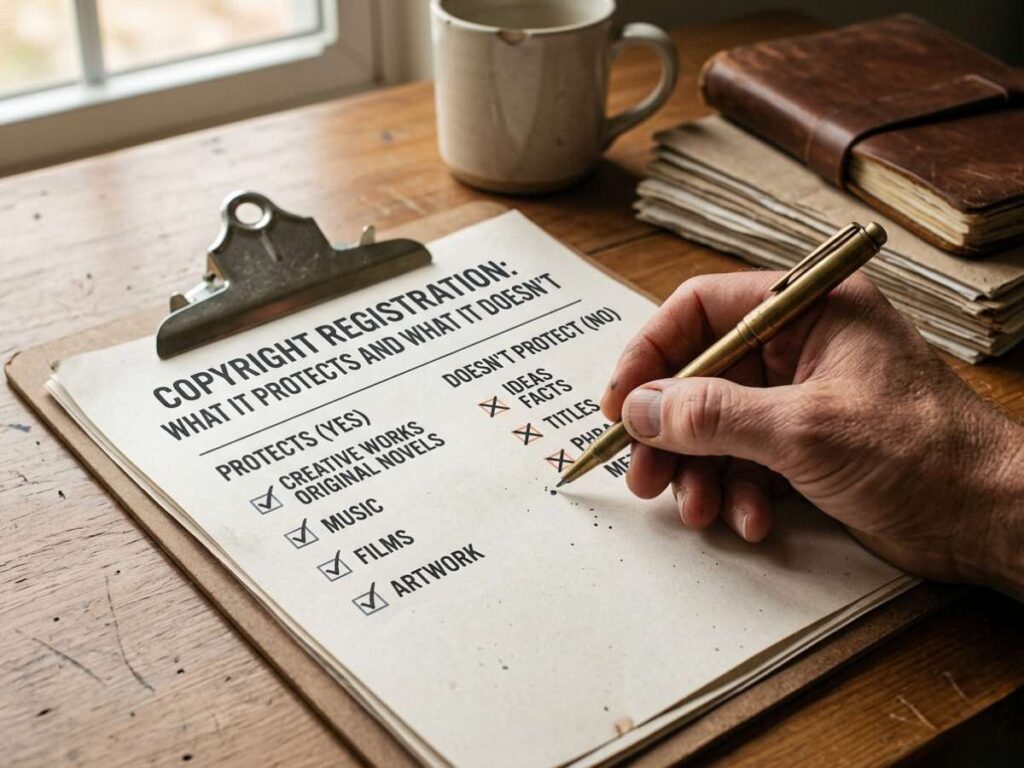
Copyright registration does not create copyright; your work is protected the moment it’s fixed in a tangible form. What registration does is unlock the legal tools to enforce that protection: the right to sue in federal court, eligibility for statutory damages and attorneys’ fees, and a permanent public record of ownership. Without it, your copyright exists but may be practically unenforceable. This article covers exactly what registered copyright protects, what it explicitly does not cover, and how to register correctly.
What Is Copyright and When Does It Begin?
Copyright is a form of legal protection granted to original works of authorship the moment they are fixed in a tangible medium of expression. That means the second you write a sentence, save a design file, record a song, or commit code to a file, copyright protection applies automatically.
No registration is required. No copyright notice (the © symbol) is required. No publication is required. The protection attaches at the moment of creation, provided the work meets two criteria: it must be original (independently created, not copied) and it must show at least a minimal degree of creativity. The U.S. Supreme Court has said the threshold is low, a “spark” and “modicum” of creativity is enough.
Works covered by copyright include:
- Literary works (books, articles, blog posts, scripts)
- Musical compositions and sound recordings
- Visual art, photographs, illustrations, and graphic designs
- Software and computer code
- Film and audiovisual works
- Architectural works (created on or after December 1, 1990)
- Dramatic works and choreography
At the international level, protection extends to most countries through the Berne Convention, which has nearly 180 member states. The U.S. joined in 1989. Under the Berne Convention, copyright lasts for a minimum of the author’s life plus 50 years. In the U.S. and EU, that term is life plus 70 years.
What Does Copyright Actually Protect?
Copyright protects expression, not ideas. This is the foundational concept of copyright law, called the idea-expression dichotomy, and it draws a firm line between what is and isn’t protected.
If you write a novel about a detective solving crimes in 1920s Chicago, copyright protects your specific characters, dialogue, plot structure, and prose. It does not protect the idea of a detective story set in 1920s Chicago. Another author can write a completely different detective novel with the same setting. What they cannot do is copy your sentences, reproduce your chapters, or create a film adaptation without your permission.
Once a work is registered, the copyright owner holds a bundle of exclusive rights under 17 U.S.C. § 106:
- Reproduction: the right to make copies
- Distribution: the right to sell, rent, or transfer copies
- Derivative works: the right to adapt (translations, sequels, film adaptations, remixes)
- Public performance: the right to perform the work publicly (music, plays, films)
- Public display: the right to display visual works publicly
- Digital audio transmission: the right to stream sound recordings
These rights apply to both published and unpublished works. Copyright is not a one-time shield against a single infringer; it is an ongoing set of rights you can license, sell, assign, or enforce in court.
Copyright vs. Patent vs. Trademark: A Quick Comparison
| IP Type | What It Protects | Registration Required? | Duration (U.S.) |
| Copyright | Original expression — books, music, art, software, film | No (but required to sue in U.S. federal court) | Life of author + 70 years |
| Trademark | Brand identifiers — names, logos, slogans used in commerce | Not required, but strongly recommended | Indefinite, renewable every 10 years |
| Patent | Inventions, processes, designs, plant varieties | Yes, protection only exists after a grant | 20 years (utility); 15 years (design) |
What Copyright Does NOT Protect
This is where most creators hit a wall. Copyright registration is powerful, but it has firm legal limits. Understanding what falls outside its scope is just as important as knowing what’s inside.
Ideas, concepts, systems, and methods are never protectable by copyright, no matter how original. Only the expression of a drug formula, the rules of a board game, or the algorithm behind a software product (the written description, the game manual, the actual code) can be protected.
Facts and data belong to everyone. Historical events, scientific findings, news reports, and statistical data cannot be copyrighted. A journalist can copyright the specific words of an article, but not the underlying facts reported in it.
Titles, names, short phrases, and slogans are explicitly excluded. “Just Do It” is not a copyrightable phrase; it’s a trademark. If you want to protect a brand name, logo, or tagline, you need trademark registration through the USPTO, not the Copyright Office.
Works in the public domain have no copyright protection. This includes works whose copyright has expired, works published before 1928 in the U.S. (as of 2026), and works created by the federal government.
Functional elements are covered by patent law, not copyright. The mechanical design of a product, an industrial process, or a new invention cannot be protected through copyright registration.
Domain names are not copyrightable. A domain name is an address, not a creative work. Protect your domain by registering it with a registrar, and your brand name by trademarking it.
Practical note: If you want to protect a logo, a brand name, or an invention process, you need trademark or patent protection — not copyright registration. Many creators lose time (and infringement cases) by applying the wrong type of IP protection to their work.
Why Register? The Real Benefits of Copyright Registration
Given that copyright is automatic, the obvious question is: why bother registering? The answer is that automatic protection and enforceable protection are two different things. Registration is what converts a theoretical right into a practical legal weapon.
- A prerequisite to filing a federal lawsuit. For U.S. works, you cannot file a copyright infringement suit in federal court without a registration certificate (or a refusal from the Copyright Office). Your copyright may be real, but without registration, you have no access to the court system to enforce it.
- Statutory damages and attorney’s fees. This is arguably the most financially significant benefit. If you register before infringement begins or within three months of first publication, you qualify for statutory damages of up to $150,000 per work for willful infringement, plus attorney’s fees. Without timely registration, you’re limited to actual damages (the provable revenue you lost), which are typically far lower and more expensive to establish in court.
- Prima facie evidence of validity. If you register within five years of publication, the registration certificate is legally presumed to be valid in court. The burden shifts: the infringer must prove your copyright is invalid, rather than you proving it’s real.
- Public record of ownership. Registration creates an official searchable record at the U.S. Copyright Office. This helps licensees find you, documents your ownership history if it’s ever challenged, and puts potential infringers on clear legal notice.
- U.S. Customs protection. You can record a registered copyright with U.S. Customs and Border Protection (CBP) to block the importation of infringing copies of your work from abroad.
- Satisfies mandatory deposit. The Copyright Act requires copyright owners to deposit two copies of published works with the Library of Congress. Submitting a registration application with deposit copies typically satisfies this requirement automatically.
Timely registration is the difference between recovering up to $150,000 in statutory damages and being limited to only what you can prove in lost revenue, which is rarely enough to cover the cost of litigation itself.
How to Register a Copyright
The process is straightforward. The U.S. Copyright Office handles all registrations, and the online system is the fastest and most affordable route.
- Go to copyright.gov and access the eCO system. The electronic Copyright Office (eCO) is the online registration portal. Create an account if you don’t have one.
- Choose the correct application type. Single work, group of unpublished works, and group registration for contributions to periodicals all have different forms. Choosing the wrong form can delay or invalidate your registration.
- Pay the nonrefundable filing fee. Online filing fees are lower than paper submissions. Fees vary by application type. Check copyright.gov for current rates.
- Submit your deposit copy. This is the actual work being registered. For most online applications, this is an uploaded digital file. For certain categories (e.g., published works), specific deposit requirements apply.
- Note your effective registration date. The effective date is set on the day the Copyright Office receives all three elements in proper form: the application, the filing fee, and the deposit. It is not set on the date the registration certificate is issued.
Processing times vary. Online filings typically take 3 to 10 months. Paper submissions can take 8 to 15 months or longer. If you need faster processing (for example, if litigation is pending), the Copyright Office offers expedited handling for an additional fee.
The most important timing rule: register before infringement occurs or within 3 months of first publication to preserve your full range of legal remedies, including statutory damages and attorneys’ fees.
Common Copyright Registration Mistakes to Avoid
Waiting until after infringement occurs. Once someone infringes your work and you register after the fact, you’ve already lost access to statutory damages and attorney’s fees. You can still sue, but your recovery options are far more limited and expensive to pursue.
Treating a copyright notice as registration. Displaying © 2026 Your Name on your work puts people on notice, but it does not constitute registration. The two are entirely separate. A copyright notice has no legal substitute for a filed registration certificate.
Relying on “poor man’s copyright.” Mailing a copy of your work to yourself to establish a date of creation has no legal standing under U.S. copyright law. The Copyright Office and courts do not recognize it as a substitute for actual registration. It is not a real legal strategy.
Assuming one registration covers a body of ongoing work. A single copyright registration covers a single work (or a defined group of works). If you publish new articles, designs, or software updates regularly, each requires its own registration; otherwise, use group registration options where available to register multiple works efficiently.
Work With an Intellectual Property Attorney
Understanding copyright registration is one thing. Enforcing it or building a complete IP strategy that covers copyright, trademark, and trade secrets together is where an experienced attorney makes a measurable difference.
The Adcox Firm PLLC represents creators, businesses, and innovators in all aspects of intellectual property law, including copyright registration, infringement disputes, trademark protection, and licensing. With offices in Austin, Nashville, and Midland, the firm provides the strategic depth of a large practice with the personal attention your matter deserves.
Frequently Asked Questions
Do I need to register copyright to be protected?
No. Copyright protection applies automatically when an original work is fixed in a tangible medium. Registration is not required for the copyright itself to exist. However, for U.S. works, registration is required before you can file an infringement lawsuit in federal court, and timely registration is required to qualify for statutory damages and attorney’s fees.
What is the difference between copyright and trademark?
Copyright protects original creative expressions, such as books, music, art, code, and film. A trademark protects brand identifiers used in commerce, such as logos, names, and slogans. If you want to protect “the way you said something,” that’s copyright. If you want to protect “the name under which you sell it,” that’s a trademark. They cover different things and are registered through different federal offices.
How long does copyright last after registration?
For works created by an individual on or after January 1, 1978, copyright lasts for the author’s life plus 70 years. Works made for hire, anonymous works, and pseudonymous works are protected for 95 years from publication or 120 years from creation, whichever is shorter. Registration does not extend or shorten this term.
Can I register copyright for a website?
Yes, but with caveats. The original text, images, graphics, and code on a website are copyrightable, and you can register them. The domain name itself is not copyrightable. Frequently updated websites can be registered as a group with a single registration covering a defined time period, rather than filing separately for every update.
What happens if I register after someone infringes my work?
You can still register and still sue, but your remedies are limited to actual damages and infringer profits you lose access to statutory damages (up to $150,000 per work) and attorney’s fees. Actual damages are difficult to quantify and expensive to prove. Post-infringement registration is still worth doing, but it is a much weaker legal position than timely registration.
Is copyright registration valid internationally?
U.S. copyright registration is a domestic record filed with the U.S. Copyright Office. The underlying copyright, however, is recognized in roughly 180 countries through the Berne Convention, which requires member nations to honor foreign authors’ rights without requiring registration. The registration itself is a U.S. document, but the protection it enforces extends internationally at a baseline level.