
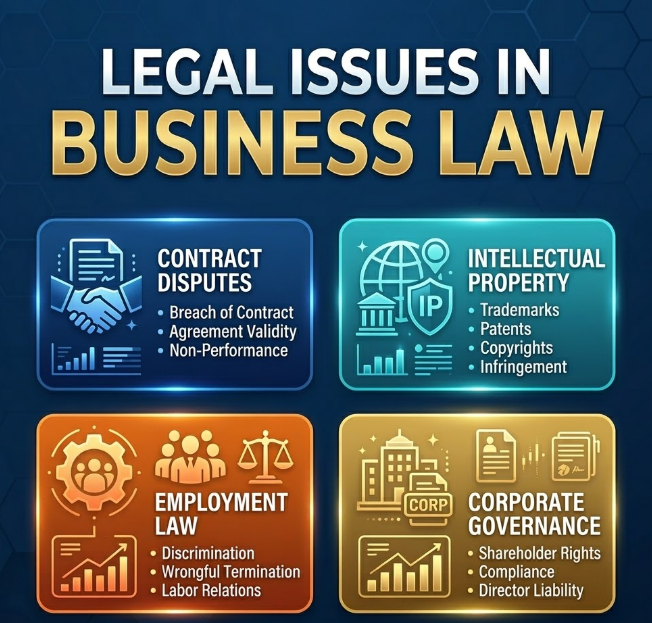
Legal issues in business law are disputes, violations, or compliance failures arising from commercial operations that expose a company to financial liability, regulatory penalties, or litigation. The most common legal issues include contract disputes, intellectual property infringement, employment law violations, regulatory noncompliance, tax reporting failures, and corporate governance deficiencies. Business law encompasses the statutes, regulations, and case law governing entity formation, commercial transactions, employer obligations, consumer protection, and industry-specific compliance. Proactively addressing these issues through qualified legal counsel, well-drafted contracts, and compliance programs reduces risk and protects long-term business value. A business attorney can help identify vulnerabilities before they become costly disputes.
What Is Business Law?
Business law is the body of federal, state, and local statutes, administrative regulations, and judicial precedents that govern commercial activity and the formation, operation, and dissolution of business entities. It provides the legal framework for how companies are organized, how they transact with customers and vendors, how they treat employees, and how they interact with government agencies. Business law includes several distinct practice areas: contract law, which governs enforceable agreements between parties; corporate law, which regulates entity formation, governance, mergers, and acquisitions; intellectual property law, which protects patents, trademarks, copyrights, and trade secrets; employment and labor law, which covers hiring, termination, wages, and workplace safety; tax law, which addresses federal and state tax obligations; consumer protection law, which prevents deceptive trade practices; and regulatory compliance, which ensures businesses meet industry specific legal requirements.
Contract Disputes
A contract dispute is a legal disagreement arising when one or more parties to a binding agreement allege that the other party has failed to perform its contractual obligations. Contract disputes are the most frequently litigated issue in business law. Common causes include breach of contract (material or minor), ambiguous or poorly drafted terms, misrepresentation or fraud during contract formation, failure to include essential clauses such as indemnification, limitation of liability, or dispute resolution provisions, and disagreements over contract interpretation. Resolution methods include negotiation, mediation, arbitration, and civil litigation. Businesses can reduce the risk of contract disputes by engaging a corporate attorney to draft, review, and negotiate all commercial agreements before execution.
Intellectual Property Infringement
Intellectual property (IP) infringement occurs when a person or entity uses, reproduces, or distributes another party’s protected intellectual property without authorization. The four primary categories of IP protection are patents (inventions and processes protected under 35 U.S.C.), trademarks (brand identifiers registered with the USPTO under the Lanham Act), copyrights (original creative works protected under 17 U.S.C.), and trade secrets (confidential business information protected under the Defend Trade Secrets Act of 2016 and state Uniform Trade Secrets Acts). Infringement can result in federal litigation, injunctive relief, statutory damages, and attorneys’ fees. An intellectual property attorney can conduct IP audits, file registrations, and enforce rights through cease-and-desist letters or litigation.
Employment Law Violations
Employment law violations are legal infractions that occur when an employer fails to comply with federal, state, or local statutes governing the employer-employee relationship. Key federal employment statutes include the Fair Labor Standards Act (FLSA), which establishes minimum wage and overtime requirements; Title VII of the Civil Rights Act of 1964, which prohibits workplace discrimination based on race, color, religion, sex, or national origin; the Americans with Disabilities Act (ADA); the Family and Medical Leave Act (FMLA); and the Occupational Safety and Health Act (OSHA).
Common violations include employee misclassification (treating employees as independent contractors to avoid benefits and tax obligations), wage-and-hour violations, wrongful termination, retaliation against whistleblowers, and failure to provide required workplace accommodations. These violations can result in Department of Labor investigations, EEOC complaints, class action lawsuits, and significant financial penalties.
Regulatory Compliance and Government Enforcement
Regulatory compliance is the process of ensuring that a business adheres to all applicable federal, state, and local laws, industry regulations, and internal policies. Regulated industries such as healthcare, financial services, energy, and food production face heightened compliance obligations. Key regulatory frameworks include Securities and Exchange Commission (SEC) regulations for publicly traded companies, Federal Trade Commission (FTC) rules governing advertising and consumer protection, Environmental Protection Agency (EPA) standards for environmental compliance, and state-level licensing requirements. Noncompliance can trigger government investigations, cease-and-desist orders, civil penalties, consent decrees, and, in severe cases, criminal prosecution. Businesses should implement formal compliance programs that include written policies, employee training, internal auditing, and designated compliance officers.
Tax Law Compliance and Reporting Obligations
Tax compliance requires businesses to accurately calculate, report, and remit all federal, state, and local taxes, including income tax, payroll tax (FICA), sales and use tax, franchise tax, and excise tax. The Internal Revenue Code (IRC) establishes federal tax obligations, while each state imposes its own tax framework. In Texas, businesses pay no state income tax but must file and pay franchise tax (Texas Margin Tax) if their total revenue exceeds the current threshold. Common tax violations include failure to file returns, underreporting income, misclassifying workers to avoid payroll tax, and failing to collect and remit sales tax. Violations can result in IRS audits, penalties, interest accrual, tax liens, and criminal prosecution for fraud or evasion.
Business Entity Structure and Corporate Governance
Choosing the correct business entity structure determines personal liability exposure, tax treatment, and governance requirements. The primary entity types are sole proprietorship, general partnership, limited partnership (LP), limited liability company (LLC), S corporation, and C corporation. An LLC provides personal asset protection through the liability shield while allowing pass-through taxation. A C corporation is a separate taxable entity that can issue multiple classes of stock, making it suitable for venture capital fundraising and eventual public offering.
Corporate governance refers to the system of rules, practices, and processes by which a company is directed and controlled, including board of directors oversight, officer duties, shareholder rights, and fiduciary obligations. Failure to maintain proper corporate formalities, such as holding annual meetings, keeping minutes, and separating personal and business finances, can result in the corporate veil being pierced, exposing owners to personal liability. A corporate and securities attorney advises on entity selection, formation filings, operating agreements, and ongoing governance compliance.
Consumer Protection Laws
Consumer protection laws are federal and state statutes designed to prevent businesses from engaging in unfair, deceptive, or abusive practices that harm consumers. At the federal level, the Federal Trade Commission Act (Section 5) prohibits unfair or deceptive acts in commerce. Other key statutes include the Fair Credit Reporting Act (FCRA), the Truth in Lending Act (TILA), the Consumer Product Safety Act (CPSA), and the Telephone Consumer Protection Act (TCPA). State-level consumer protection statutes, often called Deceptive Trade Practices Acts (DTPAs), provide additional remedies, including treble damages in some jurisdictions. Businesses must ensure that advertising claims are truthful and substantiated, product labeling meets regulatory requirements, and refund and warranty policies comply with applicable law.
How to Protect Your Business from Legal Issues
The most effective way to protect a business from legal issues is to implement a proactive legal risk management strategy that addresses compliance, contracts, intellectual property, employment practices, and insurance before disputes arise.
Retain qualified legal counsel. A business attorney provides ongoing guidance on entity compliance, contract negotiation, regulatory changes, and dispute resolution. Engaging counsel before problems arise costs substantially less than reactive litigation.
Draft and review all contracts with legal oversight. Every commercial agreement, including vendor contracts, client service agreements, partnership agreements, and employment contracts, should be reviewed by an attorney to ensure enforceability and adequate protection.
Register and protect intellectual property. File trademark registrations with the USPTO, register copyrights with the U.S. Copyright Office, and implement trade secret protection programs, including nondisclosure agreements (NDAs) and non-compete agreements where enforceable.
Build a compliance program. Develop written policies addressing employment law, data privacy, industry regulations, and financial reporting. Train employees regularly and conduct internal audits.
Obtain adequate business insurance. Policies to consider include general liability insurance, professional liability (errors and omissions), directors and officers (D&O) insurance, employment practices liability insurance (EPLI), and cyber liability insurance.
Get Legal Guidance Before Problems Become Lawsuits
Every business faces legal risk. The difference between companies that thrive and those that face costly litigation is whether they address legal issues proactively or reactively. A single unreviewed contract, missed regulatory filing, or unregistered trademark can expose your business to liability that far exceeds the cost of prevention.
Schedule a consultation with The Adcox Firm today. Our attorneys in Austin, Nashville, and Midland practice across corporate and securities law, intellectual property, entertainment and media, and energy law. Whether you need contract review, IP registration, entity formation, or regulatory compliance guidance, we provide the legal foundation your business needs to grow with confidence.
Frequently Asked Questions
1. What are the most common legal issues in business law?
The most common legal issues in business law are contract disputes, intellectual property infringement, employment law violations, regulatory noncompliance, tax reporting failures, and corporate governance deficiencies. Each of these areas carries the risk of litigation, government penalties, or financial loss. Retaining a business attorney and implementing proactive compliance programs are the most effective preventive measures.
2. What is a breach of contract in business law?
A breach of contract occurs when one party to a binding agreement fails to perform its contractual obligations without a legally recognized excuse. Breaches can be material (substantial failure that defeats the contract’s purpose) or minor (partial nonperformance that does not destroy the agreement’s value). Remedies include compensatory damages, specific performance, or rescission of the contract.
3. When should a business hire a business attorney?
A business should hire a business attorney before formation to select the right entity structure, and during operations to handle contract drafting, IP registration, employment compliance, and regulatory matters. Legal counsel is especially critical before signing major contracts, entering partnerships, raising capital, or responding to government investigations. Proactive legal advice prevents costly disputes.
4. What is regulatory compliance in business law?
Regulatory compliance is the process of ensuring a business operates in accordance with all applicable federal, state, and local laws and industry-specific regulations. Key agencies include the SEC, FTC, EPA, and state licensing boards. Noncompliance can result in fines, consent decrees, license revocation, and criminal prosecution. Formal compliance programs reduce enforcement risk.
5. How can businesses resolve legal disputes without going to court?
Businesses can resolve disputes through alternative dispute resolution (ADR) methods, including mediation, in which a neutral third party facilitates negotiations, and arbitration, in which a neutral arbitrator issues a binding decision. ADR clauses should be included in commercial contracts to establish the resolution process before disputes arise. ADR is typically faster and less expensive than traditional litigation.
6. What insurance does a business need to protect against legal risks?
Essential business insurance policies include general liability insurance, professional liability (errors and omissions), directors and officers (D&O) insurance, employment practices liability insurance (EPLI), commercial property insurance, and cyber liability insurance. The right coverage depends on your industry, business size, and specific risk profile. An insurance broker and business attorney can assess your needs.